
The Strike That Shocked Athens: Gender and Power in Lysistrata
Picture a room full of the most powerful men in a city, utterly stuck. Not because an enemy army is at the gates, not because the treasury has run dry, but because their wives have locked the bedroom door and thrown away the key. That is the premise Aristophanes builds his most famous comedy around, and it is worth sitting with how strange it must have felt in 411 BCE Athens, a city where women could not vote, could not own significant property, and were legally represented in public life by their husbands or fathers. Into that world walks Lysistrata, a woman who decides that if men will not stop making war, women will simply stop making anything else easy for them either.
A City That Didn’t Expect Women to Speak
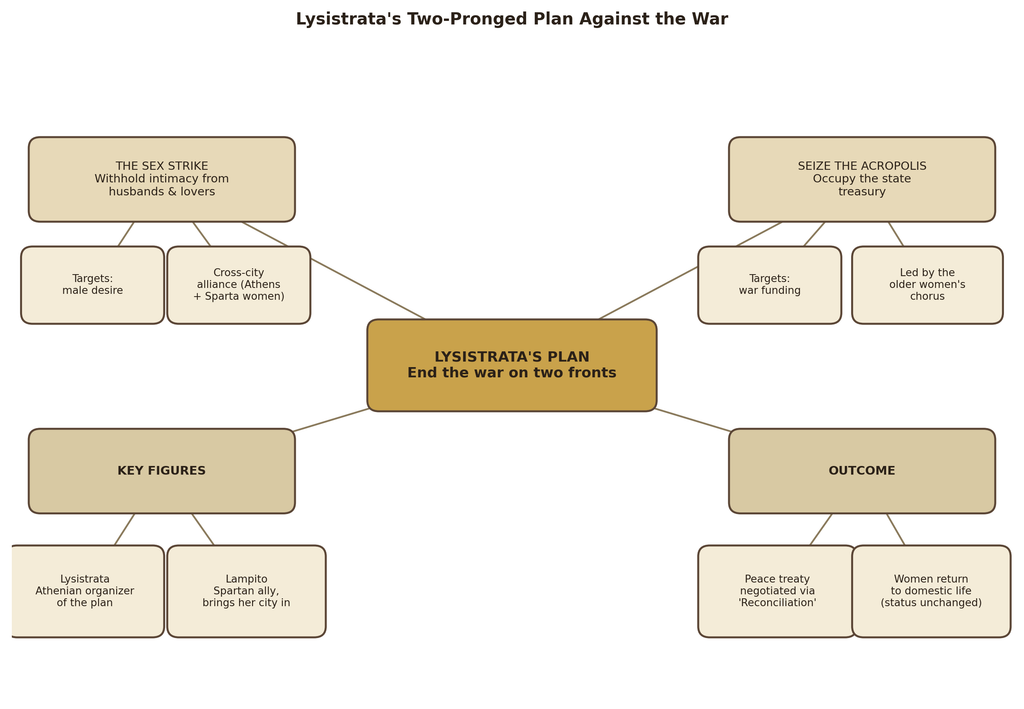
Classical Athens ran on a strict division of space. The public world of the assembly, the courts, and the battlefield belonged to men; the private world of the household, the oikos, belonged to women, who were expected to manage domestic affairs and stay largely out of sight of male citizens outside their own families. Respectable Athenian women were rarely even named in public speech unless they were dead or scandalous, so the very idea of a woman standing at the center of a play and organizing a citywide political movement would have struck the original audience as absurd before a single joke was told. Aristophanes leans into that absurdity rather than smoothing it over, and that friction between “women don’t do this” and “watch this woman do exactly this” powers the whole comedy.
The Plan: Withhold Sex, Seize the Treasury
Lysistrata’s strategy has two prongs, and it is easy to remember only the racier one. The headline plan is a sex strike: women from Athens and its warring neighbor Sparta agree to refuse their husbands and lovers until the men negotiate peace, betting correctly that soldiers on leave will find abstinence harder to endure than combat. But the second prong is just as pointed and often gets less attention: the older women of Athens seize the Acropolis, where the state’s war funds are physically kept, cutting off the money that keeps the fighting going. One plan targets desire, the other targets the purse strings, and together they attack war from both the body and the bank vault. Aristophanes seems to be arguing, with a wink, that wars are sustained by both appetite and cash, and women, denied formal power, still control surprising amounts of both.
Comic Exaggeration, Serious Undercurrent
It would be a mistake to read the sex strike as a straightforward feminist manifesto, and it would be just as much a mistake to dismiss it as nothing but a dirty joke. Old Comedy, the genre Aristophanes worked in, thrived on exaggeration, crude humor, and turning the social order upside down for laughs, and Lysistrata’s premise fits that tradition perfectly: give ordinary people (or, funnier still, the most powerless people) extraordinary power for one evening and see what chaos follows. The comedy of desperate husbands with visibly obvious problems, of women sneaking away from the Acropolis with flimsy excuses about needing to air their blankets, is broad and physical. Yet underneath the bawdiness sits a genuinely radical premise: that women have a stake in whether their sons, husbands, and cities survive a war, and that their exclusion from formal decision-making does not mean they lack leverage.
Lysistrata as an Individual, Not a Symbol
What keeps the play from being a one-note joke is that Lysistrata herself is drawn as sharp, disciplined, and rhetorically skilled in ways the text does not undercut for comic effect. She out-argues the male magistrate sent to break up the Acropolis occupation, comparing the management of a city to the management of wool, an image drawn directly from women’s domestic labor, and using it to explain, patiently and a little condescendingly, how one sorts out tangled political problems the way one sorts a tangled skein of thread. She keeps the coalition of women together even as some of them try to sneak home, using guile and a manufactured prophecy to shame the waverers back into line. She negotiates the final peace between Athens and Sparta by literally personifying reconciliation, walking the delegates through a map of Greek territory rendered as the body of a woman named Reconciliation, forcing the men to look at what they are fighting over in terms of shared, embodied geography rather than abstract pride. None of this reads as parody of female leadership; it reads as competence, played for a mostly male audience who had never had to imagine such a figure taking charge.
The Limits of the Play’s Feminism
Modern readers often want Lysistrata to be a clean ancestor of feminist protest theater, and there is something to that reading, but the play resists being tidied up that way. The comedy repeatedly falls back on stereotypes it also seems to be needling: women are shown as wine-loving, sex-obsessed, and desperate to escape their own strike, which cuts against the very competence Lysistrata displays. Scholars have long debated whether Aristophanes is satirizing misogynistic assumptions by exaggerating them into absurdity, genuinely reflecting those assumptions, or doing both at once depending on the scene. The ending, too, complicates any straightforward triumph: once peace is achieved, the women largely vanish from the political stage again, and the play closes with feasting and celebration rather than any lasting change to women’s civic status. The strike ends the war, but it does not end the world that made women powerless enough to need a strike in the first place.
Why the Premise Still Lands
The reason Lysistrata’s plan continues to resonate, more than two thousand years after it was first performed, is that it identifies something true about how power actually moves through a household and a society, separate from who holds formal office. Real-world sex strikes and boycotts inspired by the play have appeared sporadically across the modern world, from Liberia to Colombia to Kenya, whenever women have looked for leverage in situations where the official channels of power were closed to them. Aristophanes could not have predicted those movements, but he understood something structural: that the people excluded from a system are not therefore powerless within it, they simply have to find the system’s soft points. Lysistrata finds two of Athens’s soft points in one afternoon, and the play has never stopped being useful for pointing that out.
A Joke With a Long Memory
What began as a bawdy comic fantasy, staged to make a war-weary Athenian audience laugh in the middle of an actual, ongoing war, has outlived the war, the city-state system, and the ancient stage itself. The strike is still funny, still a little uncomfortable, and still, underneath both of those things, a sharp piece of political thinking about who gets to withhold their labor, their bodies, and their compliance, and what happens to the people in charge when they finally do.


One thought on “The Strike That Shocked Athens: Gender and Power in Lysistrata”
I appreciate, lead to I fohnd exactly what I was llooking for.
You’ve enjded myy for dayy lng hunt! Good Blless youu
man. Haave a nice day. Byee xnxx