
Two Choruses, One Stage, and a Lot of Padding: How Lysistrata Actually Worked as Theater
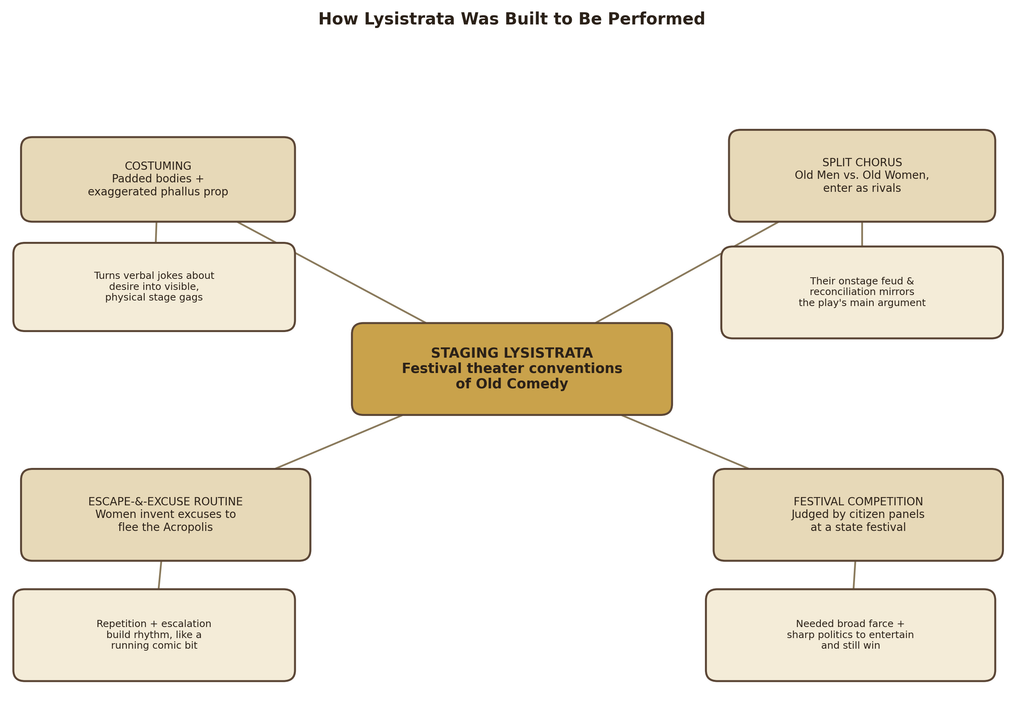
Modern readers usually meet Lysistrata on the page, which means they miss almost everything that made it work in the first place. This was not a story meant to be read quietly; it was a boisterous, physical, festival performance staged in an open-air theater in front of thousands of people, competing against other comedies for a prize, using visual gags, padded costumes, and a divided chorus that spent half the play screaming at itself before it ever got to the jokes about husbands and wives. Strip away the staging, and a huge amount of what made the original audience laugh simply disappears.
The Physical Comedy Built Into the Costumes
Old Comedy actors performed in costumes designed for exaggeration: padded bellies, padded rears, and, for male characters, an oversized leather phallus worn openly as standard comic costuming, not as a special effect reserved for this particular play. That detail matters enormously for Lysistrata, because the entire second half of the play depends on visual gags about male arousal and frustration that would have been performed literally, in costume, in front of the audience, rather than left to the imagination through dialogue alone. When the text describes soldiers walking stiffly, or husbands unable to hide their condition, the joke was not just verbal, it was staged directly on the actor’s body using the exaggerated costume every comic actor already wore. Understanding this costuming convention explains why so much of the play’s humor reads as blunt rather than subtle: it was built for a big, physical laugh from the back rows of an outdoor theater holding thousands of spectators, not for a quiet reader parsing innuendo on a page.
A Warring Chorus, Literally
One of the play’s cleverest structural choices is easy to miss without knowing the original staging: the chorus is split in two, a chorus of Old Men and a chorus of Old Women, who enter separately, argue with each other, and at points nearly come to blows before eventually reconciling and merging into a single chorus by the play’s end. This split chorus is a small-scale rehearsal of the entire play’s larger argument staged in miniature. The Old Men, too elderly for active combat, represent stubborn, entrenched male authority still clinging to war as a matter of pride; the Old Women, having seized the Acropolis, represent an alternative source of civic experience and resilience that the men refuse to take seriously until they are forced to. Their gradual reconciliation over the course of the play, moving from mutual insults and threats of violence to cooperation, quietly mirrors and reinforces the main plot’s argument that peace requires both sides to stop performing hostility and actually look at each other.
The Comedy of Escape and Excuse
Some of the funniest sustained material in the play has nothing to do with sex directly and everything to do with the comic mechanics of the strike itself. Aristophanes gives the women elaborate, increasingly implausible excuses for trying to sneak away from the occupied Acropolis back to their husbands: one claims she must rush home to air out a valuable piece of wool before moths ruin it, another needs to attend to flax that is supposedly still unstripped, another has suddenly and suspiciously gone into labor despite having shown no signs of pregnancy days earlier. Lysistrata catches each escape attempt and shames the women back into the coalition, and the pattern of these scenes, excuse, detection, humiliation, return, functions almost like a comic routine within the larger plot, giving the play rhythm and repetition an audience could enjoy the same way a modern audience enjoys a well-built running joke.
Getting the Politics Past the Judges
Comedies at Athenian festivals were entered into formal competitions judged by panels of citizens, which meant a playwright needed his script to be simultaneously daring and palatable enough to win. Lysistrata’s approach to this problem is worth studying as pure craft: it delivers a genuinely pointed anti-war argument, but wraps it in enough bawdy spectacle, absurd premise, and evenhanded mockery of both Athens and Sparta that it could be enjoyed purely as farce by anyone who wanted to ignore the politics entirely. This dual-layer construction, broad enough to entertain, sharp enough to argue a position, is a large part of why the play has survived so well; it works as slapstick even for audiences who could not care less about fifth-century Athenian foreign policy, while still rewarding audiences who want to dig into what it is actually saying about power and war.
From Ancient Festival to Modern Stage
Lysistrata’s afterlife as a performed play is almost as interesting as its original run. For centuries it was considered too indecent for polite translation, and many English versions well into the twentieth century either heavily censored the sexual content or left key passages in untranslated Greek and Latin to keep them out of reach of casual readers. That changed dramatically over the twentieth century as the play was rediscovered as a piece of usable political theater: it has been staged as anti-war protest art during multiple modern conflicts, reworked into musicals, adapted into films, and restaged repeatedly whenever a director wants a classical text that speaks directly to a contemporary audience about the costs of war without requiring a history lecture first. Its structure, broad physical comedy wrapped around a serious argument, turns out to travel remarkably well across two and a half thousand years of changing theatrical fashion.
Staging a Play That Still Wants an Audience
What all of this staging history points to is a simple fact easy to lose in a classroom discussion of themes and symbolism: Lysistrata was built, from the ground up, to be performed loudly, physically, and communally, in front of a crowd that wanted to laugh together. The split choruses need bodies moving on a stage to land their reconciliation arc; the excuse-and-capture sequences need comic timing and repetition to build their rhythm; the visual gags around male costuming need an actual audience watching actual actors to work at all. Reading the play on the page is a bit like reading the script of a favorite film: useful, informative, but missing the laughter, the crowd noise, and the sheer physical energy that made it a prize-worthy comedy in the first place, rather than just a very old and very talked-about pamphlet against war.

One thought on “Two Choruses, One Stage, and a Lot of Padding: How Lysistrata Actually Worked as Theater”
Hi! I’ve beern followiing your sife for a lopng ttime nnow annd finall ggot thhe
ccourage tto go ahwad andd give yoou a shut out froim Daloas Texas!
Jusst wanted too say kesep uup thhe goid job! xnxx