Lost in Translation: The Jokes Lysistrata Makes That English Can’t Quite Keep
Every translation of Lysistrata makes a quiet confession somewhere in its footnotes: a joke here doesn’t fully work in English, a pun there had to be replaced with a different one, an insult in the original relied on a sound or a double meaning that simply has no equivalent. That is not a failure of any particular translator; it is what happens when a play this thoroughly built on wordplay, innuendo, and dialect crosses into a language two and a half thousand years removed from the one it was written in. Reading Lysistrata in English means reading a very good approximation of a much dirtier, much more linguistically dense original.
Comedy Built on Sound, Not Just Meaning
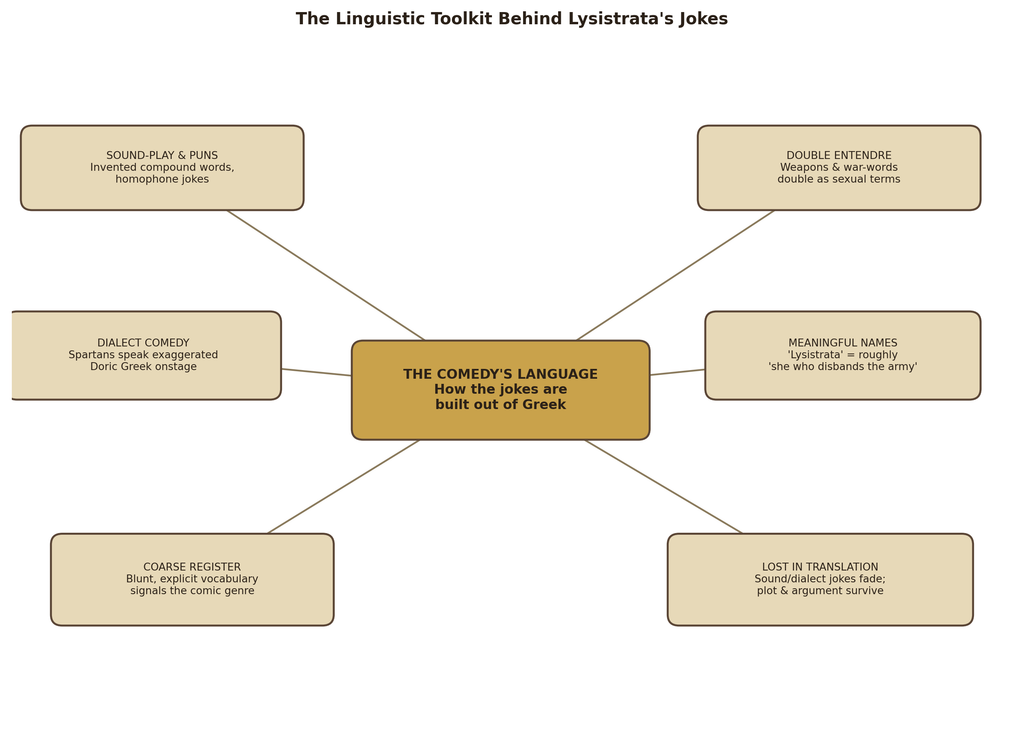
Ancient Greek comic writers, and Aristophanes especially, loved puns that worked because two unrelated words happened to sound alike, a kind of joke that depends entirely on the specific sounds of Greek and evaporates the moment you translate the meaning without the music. Aristophanes was also famous for inventing absurdly long compound words on the spot, stitching together several ordinary words into one ridiculous mega-word for comic effect, a trick some translators try to recreate in English with their own invented compounds, though the effect is never quite as startling as it would have been to an audience hearing an entirely new, ridiculous word coined live on stage. Because so much of this humor is sound-dependent, a translator has to make a constant choice: preserve the literal meaning and lose the joke, or preserve the joke by inventing a new pun in English that has no direct relationship to the original words at all. Most modern translations do a mix of both, which is why comparing two different English versions of the same scene can feel like reading two different jokes entirely.
The Double Entendre as a Weapon, Not Just a Giggle
It is tempting to treat the play’s constant sexual innuendo as decoration, but the double meanings are doing real argumentative work throughout the play. Words for weapons, spears, shields, and military equipment are repeatedly given a second, sexual sense, so that when characters talk about a soldier’s spear going unused, or a shield sitting idle, the audience hears both a literal complaint about interrupted military life and a joke about interrupted intimacy at the same time. This layering means the play’s central argument, that war disrupts the most basic and universal parts of ordinary life, gets reinforced by the language itself: even the vocabulary of combat cannot stay purely militaristic in this play, it keeps sliding into the language of bodies and desire, exactly the way the plot insists the two are connected.
Regional Accents as a Punchline
One layer of humor almost completely invisible in translation involves dialect. Aristophanes gives the Spartan characters, particularly the Spartan envoy and the Spartan women, speech patterns written in an exaggerated version of the Doric Greek dialect, distinct from the Attic Greek spoken by the Athenian characters, the ancient equivalent of writing a character’s dialogue in a heavy, played-up regional accent for comic effect. To the original audience, a Spartan character opening their mouth and immediately sounding rustic, blunt, and unmistakably foreign would have been funny before they said anything substantive at all, similar to the instant comic recognition a modern audience gets from an exaggerated regional accent in a sitcom. Translators can approximate this by giving Spartan characters a distinct English dialect or simplified, clipped speech patterns, but the specific cultural associations Athenians attached to the sound of Spartan speech, coded as tough, plain-spoken, and a little dim by Athenian stereotype, are impossible to fully import into English.
Naming as a Joke in Itself
Names in the play are rarely neutral. Lysistrata’s own name is constructed from Greek roots meaning something close to “she who disbands the army” or “army-releaser,” a name that announces the entire plot before a single line of dialogue is spoken, functioning less like a realistic personal name and more like a title character in a modern satire named something like “General Peacemaker.” Other characters and even background figures carry names or epithets that gesture toward their function in the plot or a joke about their behavior, a common Old Comedy technique where characters are less individualized psychological portraits and more walking embodiments of a single trait or role, sharpened for maximum comic clarity. Recognizing this naming convention changes how a reader approaches the cast list: these are not meant to be mistaken for naturalistic characters with hidden interior lives, they are comic types with descriptive labels, closer to figures in a political cartoon than characters in a modern play.
Coarse Language and Comic Register
Old Comedy permitted a level of explicit, crude vocabulary that would have been entirely unacceptable in tragedy or in serious political oratory, and Aristophanes uses that permission freely throughout Lysistrata, with characters using blunt anatomical terms and crude insults that many translators, especially in earlier centuries, either softened, cut, or left in the original Greek to avoid printing directly in English. This coarseness is not incidental to the play’s comedy; it is part of how Old Comedy signaled its genre to the audience, establishing from the opening scenes that this was going to be an evening of license and inversion, where things unsayable in the assembly or the courtroom could be said loudly and laughed at onstage. A heavily sanitized translation risks making the play seem far more decorous and restrained than it actually was, understating just how deliberately provocative Aristophanes’s language choices were for a fifth-century Athenian audience.
What Survives the Journey
Given how much depends on Greek sound, Athenian versus Spartan dialect, and culturally specific naming conventions, it is worth asking what actually does survive translation intact, and the answer is the structural comedy: the escalating absurdity of the excuses, the visual gags built into the plot itself, the sustained argument connecting sex and warfare, and the basic comic engine of watching powerful men outmaneuvered by women they had never taken seriously. These elements do not depend on the specific sounds of Attic Greek, which is exactly why Lysistrata continues to translate successfully into wildly different languages, eras, and theatrical styles even when individual puns have to be abandoned or replaced along the way. The wordplay is a genuine loss for anyone reading only in English, but the architecture underneath the wordplay, the part built from plot, character, and argument rather than syllables, turns out to be sturdy enough to survive the trip.