Twenty Years of War and One Very Tired Comedy
By the time Lysistrata premiered in 411 BCE, Athens and Sparta had already been at war, on and off, for two decades. Imagine a city where an entire generation had grown up not knowing peacetime, where every festival season carried the possibility of a call-up notice, and where a recent military disaster had just wiped out tens of thousands of citizens in a single catastrophic campaign. That is the Athens Aristophanes wrote for, and the exhaustion of that audience is baked into every line of the play. Lysistrata is not just a sex comedy; it is a piece of wartime theater performed for people who were, in every real sense, sick of the war before the curtain ever rose.
The Peloponnesian War, in Brief
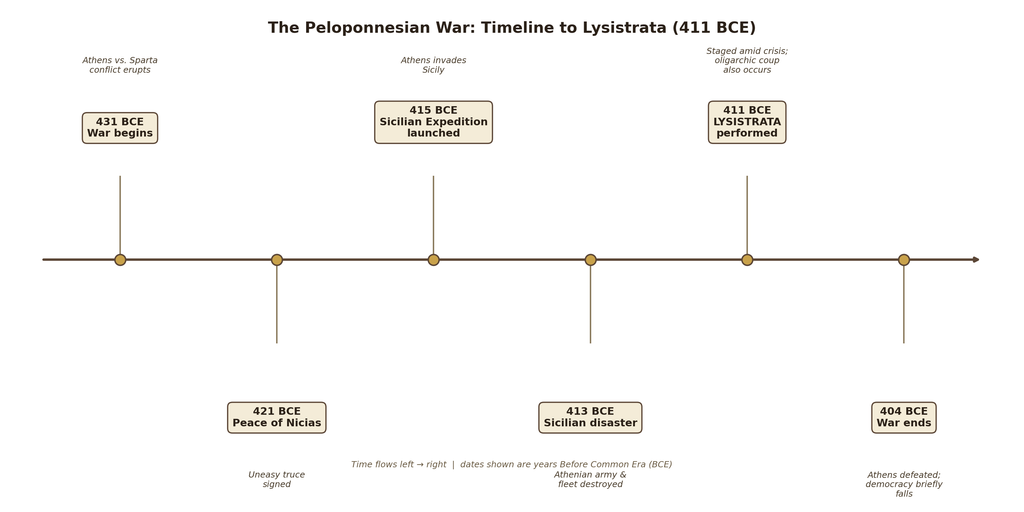
The conflict pitted Athens, a naval empire built on trade, tribute, and its powerful fleet, against Sparta, a land power built on rigid military discipline and a network of allied city-states across the Peloponnese. The war had already run through two distinct phases by 411: an earlier decade of fighting that ended in an uneasy truce, followed by a renewed and far more dangerous phase after Athens attempted to expand its empire by invading Sicily, a campaign that ended in the near-total destruction of the Athenian fleet and army in 413 BCE. That disaster is the immediate backdrop to Lysistrata. Athens, in 411, was a city reeling from catastrophic losses, facing revolts among its allies, and about to undergo a brief but genuinely frightening collapse of its democratic government into oligarchic rule. The comedy was staged into that atmosphere of crisis, not staged as safe nostalgic entertainment after the danger had passed.
Comedy as a Form of Political Speech
Athenian Old Comedy occupied a strange civic position that has no exact modern equivalent. Performed at state-sponsored festivals in front of thousands of citizens, comic playwrights were given remarkable license to mock living politicians by name, lampoon current policies, and stage outrageous “what if” scenarios about the city’s problems, all as part of a competition judged by the audience itself. Aristophanes used this license throughout his career, and by 411 he had already built a reputation for anti-war comedies, including earlier plays that dramatized ordinary citizens making private peace deals with the enemy out of sheer frustration with the political class. Lysistrata continues that project but escalates the “what if”: instead of one farmer negotiating his own private truce, an entire coalition of women across the warring Greek world coordinates a single, simultaneous strike against the war itself.
Who Gets Mocked, and How Carefully
It is worth noticing who Aristophanes does and does not spare. The magistrate who confronts Lysistrata at the Acropolis is a stand-in for the entire apparatus of male political authority, and he is made to look foolish, outmaneuvered by a woman using a domestic metaphor he cannot counter. Yet Aristophanes is careful not to make the play a simple attack on Athens alone; Spartan women are recruited into the same strike, Spartan soldiers suffer the same comic indignities as Athenian ones, and the eventual peace negotiation treats both sides’ territorial grievances with the same mocking evenhandedness. This matters because outright calls for surrender or for abandoning the war effort could have been read as dangerously close to treason in a city under this much strain; by making the joke land equally on both warring parties, and by channeling the anti-war message through the socially “safe” absurdity of a women’s sex strike rather than direct political argument, Aristophanes could say something close to “this war has gone on long enough” without saying it in his own voice as a citizen addressing the assembly.
Reconciliation as a Body on a Map
The play’s imagining of peace is worth lingering on because it is unusually visual and unusually physical for a political argument. When the Athenian and Spartan delegates finally sit down to negotiate, Lysistrata does not hand them a treaty document; she presents them with a silent female figure, Reconciliation, whose body is described in terms that double as a map of Greek territory, with specific regions correlated to specific parts of her form. The delegates, distracted and worn down by weeks without their wives, argue over which “territories” they should be allowed to claim, and the joke works on two levels at once: it mocks the men’s inability to separate desire from diplomacy, and it reframes the war itself as a dispute over something that should belong to everyone, staged as a single shared body rather than a set of competing flags. It is a strange, funny, faintly uncomfortable image, and it is also one of the more sophisticated pieces of political theater in the whole play.
A Fantasy, Not a Forecast
None of this means Aristophanes expected the play to actually stop the fighting, and it did not; the war ground on for another seven years after Lysistrata’s premiere, ending only in 404 BCE with Athens’s total defeat and the temporary loss of its democracy. Comedy at the City Dionysia and Lenaia festivals functioned less as policy proposal and more as a pressure valve, a licensed space where a war-exhausted citizenry could imagine, for a few hours, a version of events in which someone, anyone, had the power to simply make the fighting stop. That the imagined “someone” was a coalition of women, the group with the least formal power in the entire system, only sharpens the fantasy: the play essentially argues that ending the war would require an intervention so unlikely, so far outside the normal channels of Athenian politics, that only a citywide sex strike run by women could pull it off, which is itself a quiet, bitter joke about how stuck the actual political class had become.
Reading the War Behind the Wit
Understanding the military and political situation of 411 BCE does not strip Lysistrata of its comedy, it sharpens it. Every joke about husbands too soldier-worn to argue, every reference to depleted treasuries, every appearance of the visibly frustrated male chorus carries the specific weight of a city that had just lost an army in Sicily and was about to lose its own government to a coup. The play’s fantasy of instant peace is funny precisely because the audience knew, better than any modern reader can, exactly how far out of reach real peace actually was. Comedy, in Aristophanes’s hands, becomes a way of naming a crisis too large to name directly, wrapping the city’s exhaustion in a plot absurd enough to get past both the censors of propriety and the audience’s own despair.