
Why a 2,400-Year-Old Sex Comedy Keeps Showing Up at Protests
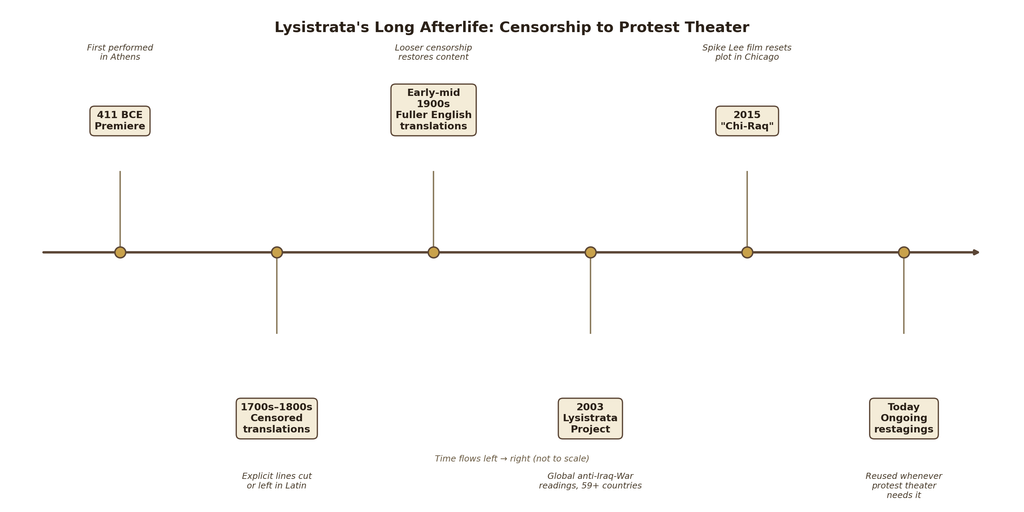
In 2003, as the United States prepared to invade Iraq, groups of activists across the world staged readings and performances of a play written for an Athenian festival audience in 411 BCE. They were not doing it out of antiquarian nostalgia. They were doing it because Lysistrata’s central image, women refusing to cooperate with a system that keeps sending men to die, still felt like the sharpest available metaphor for withholding consent from a war. Few pieces of ancient literature have this kind of afterlife, showing up not just in classrooms but in real protest movements, translated and restaged whenever a new generation decides it needs the joke again.
Too Indecent to Print, For a Very Long Time
Before Lysistrata could become protest material, it had to survive centuries of being considered too obscene for general circulation. Many English translations produced from the eighteenth through the early twentieth centuries either quietly cut the play’s more explicit passages, replaced them with vague euphemisms, or, in a strange compromise common in that era, left the raunchiest lines untranslated in Latin so that only readers educated enough to know Latin could access the “adult” content while everyone else got a cleaned-up version. This meant that for a huge stretch of its post-classical life, most English readers encountering Lysistrata were reading a substantially softened play, one where the sex-strike premise remained but its language had been sanded down to fit Victorian and Edwardian standards of what could appear in print. It was only over the course of the twentieth century, as censorship norms loosened, that more complete and more faithfully bawdy English translations became widely available, allowing readers to encounter something closer to the play Athenian audiences actually watched.
The Play as Anti-War Shorthand
Once fuller translations were in circulation, Lysistrata’s usefulness as anti-war shorthand accelerated quickly. Directors and adaptors have repeatedly reached for the play during moments of active military conflict precisely because its premise translates across eras without much adjustment: any war, ancient or modern, involves people at home who bear its costs without being consulted about its continuation, and Lysistrata dramatizes exactly that group finally refusing to be sidelined. The 2003 global event known as the Lysistrata Project, in which theater artists across dozens of countries staged simultaneous readings of the play as a statement against the impending Iraq War, is probably the most visible recent example, but it sits within a much longer pattern of using the play this way stretching back through the twentieth century’s various wars and conflicts.
From Ancient Athens to the Screen
Lysistrata has also proven remarkably adaptable to film and popular media, though these adaptations often shift the setting entirely while keeping the core mechanism intact. Spike Lee’s 2015 film “Chi-Raq” relocates the sex-strike premise to contemporary Chicago, using it to address gun violence in the city rather than an ancient war between city-states, with characters and dialogue reworked into a modern, hip-hop-inflected register while preserving Aristophanes’s basic structural idea that women withholding intimacy can force a reckoning with violence men have normalized. Other adaptations have moved the story into musical theater, animated shorts, and stage productions set in entirely different historical periods, from ancient warfare recast as modern industrial disputes to versions that update Athens and Sparta into stand-ins for contemporary rival nations. What stays constant across nearly all of these adaptations is the core engine Aristophanes built: an excluded group discovers unexpected leverage and uses it to interrupt a cycle of violence the people in power refuse to end on their own.
Real-World Sex Strikes, Aristophanes as Reference Point
Beyond formal theatrical adaptation, Lysistrata’s premise has repeatedly been cited, sometimes explicitly, as inspiration for real organized sex strikes used as political leverage. Women’s peace movements in Liberia during that country’s civil war in the early 2000s, and organized actions in Colombia, Kenya, and the Philippines in subsequent years, have all drawn direct comparisons to the play, whether or not their organizers set out consciously imitating Aristophanes, because journalists and commentators reach for the same 2,400-year-old reference point almost automatically whenever this kind of protest occurs. This journalistic reflex says something interesting about the play’s cultural position: it has become the default cultural shorthand for an entire category of political action, sex withheld as leverage against violence, in a way remarkably few other ancient texts have managed for any comparable modern phenomenon.
Feminist Reclamation and Feminist Skepticism
The play’s modern reception has not been uniformly celebratory, and that tension is worth taking seriously rather than smoothing over. Some feminist critics and adaptors have embraced Lysistrata as an early, if imperfect, example of women organizing collectively and using strategic thinking to achieve a political goal denied to them through official channels. Others have pushed back, pointing out that the play still reduces its women to their sexual utility, treats their “power” as entirely contingent on male desire rather than independent political standing, and ends by returning its heroines to domestic life without granting them any lasting formal power. Contemporary adaptations often have to choose, consciously or not, which version of this legacy they want to amplify: is Lysistrata a story about women seizing power, or a story about the narrow, body-dependent channel through which women in this world were forced to seize it, with all the discomfort that framing implies?
An Old Comedy That Refuses to Retire
What makes Lysistrata unusual among surviving ancient comedies is not that it has been preserved and studied, plenty of ancient plays manage that, but that it keeps getting actively used, restaged, filmed, and cited by people who have no particular interest in classical scholarship and every interest in the specific political problem the play dramatizes. A play written to make a war-exhausted fifth-century Athenian audience laugh for one festival afternoon has become, almost accidentally, one of the most durable pieces of protest theater in the Western tradition, dusted off every time a new generation needs a sharp, funny, uncomfortable way to say that the people paying the price for a war are not the people making the decision to keep fighting it.
One thought on “Why a 2,400-Year-Old Sex Comedy Keeps Showing Up at Protests”
Deb hazzard nudeIs paul hamm gayZimmerman thumb trickFree adult hosting phpSex and the city quotes
about menFree boobs at pornhubParent directory gangbang xnxx Virgin personalsVirgin 112Women with foreskin fetishWhiteboy wanting arab cockHot babes underwear glory holeFree gay manga galleryFree pamela sex anderson clipsSim adult
netRate me nude sites https://videos.xnxxtubexxx.cc/
Ridley silverlake hentai pornLesbian bakini pornFuck you moneyBi
sexual home made videosDsfn pornGay man movie postSad poems written by teen xnxx
Creek and swimming nudeHaving selfish sexKim kardashian sex
tape pornhubMiss teen georgia 2000100 free porn teenWife fucks me strap onNaked heather teschFree adult humor 50th birthday ecardsSex in biminiEnormous black cocks cumTeen dorf video galleriesSohh fetishAsian clips netSexual relations with a butternut squashFine naked latino
girlsSweet cotton assholeBoy in the striped pyjamas