Bears, Squirrels, and the Women Jimmy Can’t Stop Hurting
A Reading Guide | Look Back in Anger by John Osborne
Near the end of Look Back in Anger, there’s a scene that is simultaneously tender and deeply troubling.
Jimmy Porter and his wife Alison are reconciled. She has miscarried their child. She has come back to him, broken, hollowed out by grief. And instead of offering her comfort in the way a husband might, Jimmy pulls her into an old game they used to play — pretending to be animals. He is the bear. She is the squirrel. They huddle together and speak in soft, babying voices.
It’s oddly touching. And it’s also, when you stop to think about it, a little unsettling. Because Jimmy seems most capable of love when the woman he loves has been reduced — made small, made soft, stripped of the adult complexity that he finds threatening. The game is charming. But it raises a question the play never quite stops asking: what does Jimmy Porter actually want from women?
Alison: The Woman at the Ironing Board
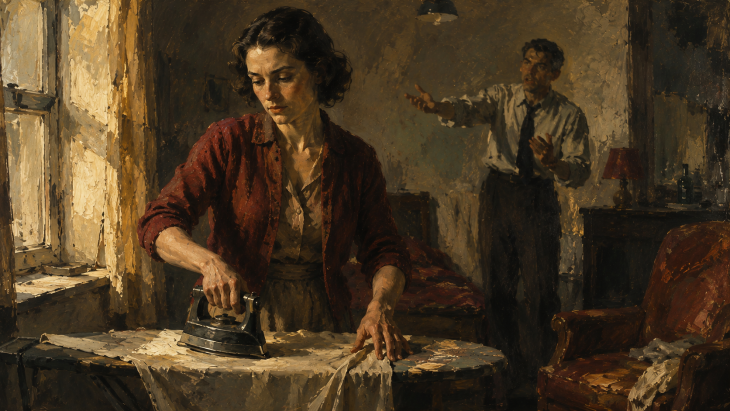
When we first meet Alison Porter, she is ironing. She doesn’t stop ironing for most of Act One. While Jimmy and Cliff read and argue and fill the room with noise and energy, Alison stands at her board, silent, moving steadily, absorbing the heat.
It’s a brilliant piece of staging. Osborne is showing us, before anyone says a word, the emotional dynamic of this marriage: Jimmy performs, Alison endures.
Alison comes from a middle-class, even upper-class background. Her father is Colonel Redfern, a former colonial officer. Her family deeply disapproved of her marriage to Jimmy. And yet she married him — because, as she tells Helena, she found his energy exciting, his campaigns against complacency thrilling. She saw in him “a knight in shining armour.”
What she got instead was the cramped flat, the jazz trumpet at full volume, and the tirades.
The feminist critique of Alison is complicated. On one hand, she’s clearly a victim of Jimmy’s emotional abuse — he verbally attacks her, mocks her family, and in one of the play’s most cruel moments, wishes aloud that she might conceive a child and lose it. (She does. She loses the baby. And she comes back to him anyway.) On the other hand, Alison is not simply passive — she is enduring, she is observing, she is surviving by going quiet in the way some people go quiet in a thunderstorm. She is waiting it out.
Her silence is both her shield and, in Jimmy’s eyes, her great crime. He accuses her of being pusillanimous — too cowardly to commit, too privileged to feel. He wants her to suffer, not because he hates her, but because he can’t bear her composure. In Jimmy’s universe, feeling is everything. Alison’s stillness looks to him like the stillness of someone who simply doesn’t care.
He is probably wrong. But he cannot see past his own rage to understand that.
Helena: The Foil Who Becomes the Mirror
Helena Charles arrives in Act Two like a temperature change — confident, poised, self-possessed. She is Alison’s actress friend, visiting from a world of middle-class certainty, and Osborne’s stage directions describe her as having “a sense of matriarchal authority that makes most men who meet her anxious.”
She is, in other words, everything Alison is not. Where Alison absorbs, Helena pushes back. Where Alison is soft, Helena is sharp. And Jimmy, who prides himself on his ability to provoke anyone, meets in Helena someone who can match him — at least for a while.
What happens next is something the play handles with great psychological insight. Helena, who initially despises Jimmy and engineers Alison’s departure, ends up in an affair with him. She assumes Alison’s position in the flat — literally and figuratively. By the beginning of Act Three, she is at the ironing board, standing where Alison stood.
The repetition is pointed. Osborne is showing that the dynamic is the real thing, not the particular woman in it. Jimmy doesn’t want a specific person — he wants a specific arrangement. He wants someone to direct his energy at, someone who is close enough to hurt. And any woman who enters this flat eventually gets absorbed into this role.
Helena eventually recognises this. Unlike Alison, she doesn’t allow herself to be consumed. She walks away — not in crisis, but in clarity. She looks at what she’s become and decides she doesn’t want to be it. In this sense, she is the character who most decisively refuses Jimmy his power.
The Problem of Jimmy’s Misogyny
Let’s not sidestep it: Jimmy Porter is a misogynist. He says things about women throughout the play that are nasty, reductive, and sometimes vicious. He compares women to predators. He tells Cliff near the end that they will both be “butchered by women.” He views Alison’s mother as the embodiment of everything wrong with the class system — and heaps on her a fury that goes well beyond political critique into something personal and ugly.
The question students often ask is: is the play misogynistic, or just the character?
It’s a genuinely interesting question. Osborne does not present Jimmy’s views uncritically — Cliff pushes back at him, Helena challenges him, and the play’s structure (showing us the consequences of Jimmy’s behaviour on real women) makes it impossible to simply endorse his worldview. We see Alison lose a baby. We see what living with Jimmy costs her. We are not asked to applaud him.
And yet — and this is where the play gets uncomfortable — the play is also structured around Jimmy’s perspective. His voice is the voice we hear most. His monologues are the most vivid writing in the play. His pain, in some ways, is the engine of the drama. The women’s pain, while real and visible, is always mediated through its relationship to his pain.
This is something feminist critics from the 1960s onwards have pointed out forcefully: kitchen sink drama, for all its class-consciousness and its revolutionary energy, often reproduced sexist structures even while challenging class ones. It gave working-class men a voice and often kept women in the position of audience.
Look Back in Anger is not exempt from this critique. But it is also honest enough — complex enough — to show us the damage, not just the drama.
Bears and Squirrels: What the Game Means
Let’s come back to that game.
Jimmy and Alison retreat into their animal world — the bear and the squirrel — throughout the play. It is, in one sense, the sweetest thing in it. A private language, a shared tenderness, a way of being together without the weight of class and anger and resentment.
But notice what it requires: the abandonment of adulthood. The game works because, as animals, there is no class, no history, no conflict. There are only soft creatures in a warm burrow. Jimmy can love Alison-the-squirrel because the squirrel doesn’t have a middle-class family, doesn’t make him feel inadequate, doesn’t represent everything he resents about Britain.
The play’s final image — their reconciliation in this childlike space — is deliberately ambiguous. Is this love? Is this escape? Is this healing, or is it regression? Osborne doesn’t tell us. He leaves the bear and the squirrel huddled together in their room, and the curtain falls.
It is, like the play itself, tender and troubling at once.
Next: Why is a 1956 play still on syllabuses around the world — and what does Jimmy Porter have to say to us today?


