The Man Who Was Too Angry for England: Jimmy Porter and Post-War Britain
A Reading Guide | Look Back in Anger by John Osborne
Picture this: it’s 1956. The Second World War ended just eleven years ago. Britain fought, won, and came home expecting — what, exactly? A better life? A fairer country? A world where a young man with brains and a university degree could actually get somewhere?
Instead, Jimmy Porter is selling sweets at a market stall.
That image — a university-educated man hawking candy in a small Midlands town — is at the heart of John Osborne’s explosive 1956 play, Look Back in Anger. And it tells you almost everything you need to know about why the play caused such a sensation the moment it hit the stage at the Royal Court Theatre in London.
Britain After the War: Victory That Felt Like Defeat
To understand Jimmy Porter’s rage, you first need to understand the world he was living in.
Think of it this way: imagine you study hard for years, pass every exam, get into a good college — and then graduate into a job market that simply doesn’t care. Your degree means nothing. The people with the connections, the right surnames, the right accents, the right schools — they still get the good jobs. You’re still on the outside looking in.
That was the reality for an entire generation of young British men in the 1950s. The war had promised change. The British Labour Party had swept to power in 1945 on a wave of hope, setting up the National Health Service, nationalising industries, building a welfare state. For a moment, it looked like the rigid old class system — where your birth determined your worth — might actually be crumbling.
But it wasn’t. Not really.
The upper classes were still in charge. The old boys’ networks still ran business and politics and the arts. A working-class accent still closed doors. And young men who’d been told that education was their ticket upward found themselves stranded in an awkward no-man’s-land: too educated for the class they came from, still not accepted by the class they aspired to.
Jimmy Porter is stuck precisely in this gap. He went to university — but a “white tile” university, not Oxford or Cambridge. He’s intelligent, passionate, articulate — but he sells sweets. He reads newspapers, plays jazz trumpet, argues politics — but he’s invisible to the world that should, by rights, have rewarded him.
His anger isn’t random. It has a target: a society that made a promise and broke it.
The “Angry Young Man” — A Generation, Not Just a Character
Osborne didn’t set out to create a type. He set out to write a play. But critics and audiences immediately recognised something in Jimmy Porter that felt larger than one man in one flat.
The phrase Angry Young Man stuck to an entire generation of post-war British writers — novelists, playwrights, poets — who were writing about disillusionment, class, and the frustration of being educated enough to see the system clearly but not powerful enough to change it. Kingsley Amis’s Lucky Jim (1954), Alan Sillitoe’s Saturday Night and Sunday Morning (1958) — these were cut from the same cloth.
What united these writers wasn’t a manifesto or a political party. It was a feeling: impatience with the status quo, refusal to be swallowed up by a bankrupt society, and an instinctive sympathy for the underdog.
Jimmy Porter is the definitive version of this figure. Unlike a polished hero in a drawing-room comedy, he doesn’t hold back. He rants. He sneers. He lashes out at his wife, his friends, and at anyone who seems too comfortable, too complacent, too happy to play by rules that he finds suffocating and unjust.
His most devastating weapon is his words. He doesn’t punch. He talks — in long, scorching monologues that attack the English obsession with politeness, with “keeping up appearances,” with pretending everything is fine when it isn’t.
Colonel Redfern: The Old World That Won’t Let Go
One of the most quietly devastating characters in the play is Alison’s father, Colonel Redfern. He’s a former colonial officer, a man who spent his best years in India running the British Empire — and then came home to an England that had moved on without him.
He tells Jimmy and Alison about returning to England after the war: “I’d lived and worked with real people, I thought. They were all real. All I could think was — it’s all over. The whole thing… finished.”
Redfern is not a villain. He’s a sympathetic figure. But he represents everything Jimmy rails against: a world built on privilege and empire that refuses to acknowledge its own obsolescence. The old order clinging on. The sense that Britain is “looking back” — locked in nostalgia for a greatness that is fading and perhaps was never as glorious as it seemed.
And here’s the painful irony: Jimmy is also looking back. The play’s title is not just about the older generation. Jimmy himself is stuck — haunted by the memory of watching his father die slowly after the Spanish Civil War, scarred by a boyhood spent witnessing adult despair and abandonment. He can’t move forward either. He can only burn.
The Stage Direction That Said Everything
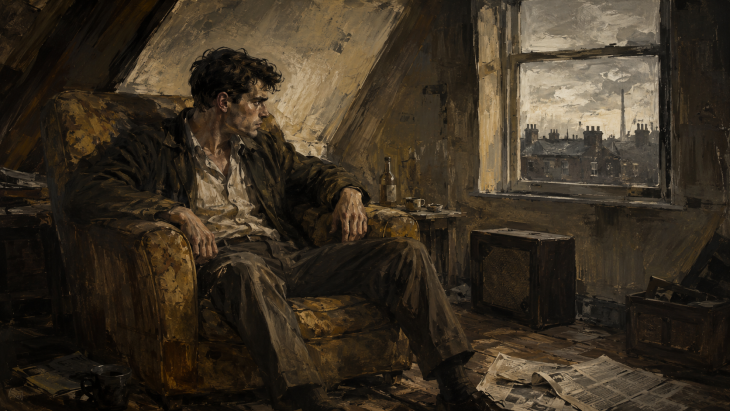
When Look Back in Anger premiered on May 8, 1956, the audience walked into a theatre and saw something they had never quite seen before: a cramped one-room flat, an ironing board, a man in a rocking chair reading the Sunday papers, and a woman silently, endlessly ironing.
No grand drawing rooms. No witty upper-class banter. No murder mystery set in a country house.
Just a small, tired, real room — and the sound of people who are suffocating inside it.
The famous critic Kenneth Tynan wrote in The Observer that the play was “the best young play of its decade.” Not everyone agreed — The Evening Standard called it a “self-pitying snivel.” But even its detractors knew that something had shifted. The English stage would never quite go back to what it was before.
Why This Still Matters
You might think that a play about a 1950s British man’s class frustrations would feel dated. But there’s something almost eerily timeless about Jimmy Porter’s predicament.
Every generation has its version of this feeling: the sense of being over-educated and under-employed, of working hard and still being shut out, of watching a system reward the already-comfortable while the rest grind along.
Jimmy Porter isn’t a hero. He’s not even particularly likeable. But he is extraordinarily honest — about his frustrations, his contradictions, and his rage. And sometimes, honesty — raw, ugly, uncomfortable honesty — is exactly what a stage, or a classroom, needs.
Next: We look at the cramped flat itself — and why the setting of Look Back in Anger is far more than a backdrop.


